GEO vs SEO: The Complete 2026 Comparison Guide
Understand the key differences between GEO (Generative Engine Optimization) and traditional SEO. Learn when to use each approach and how they work together.
Key Takeaways
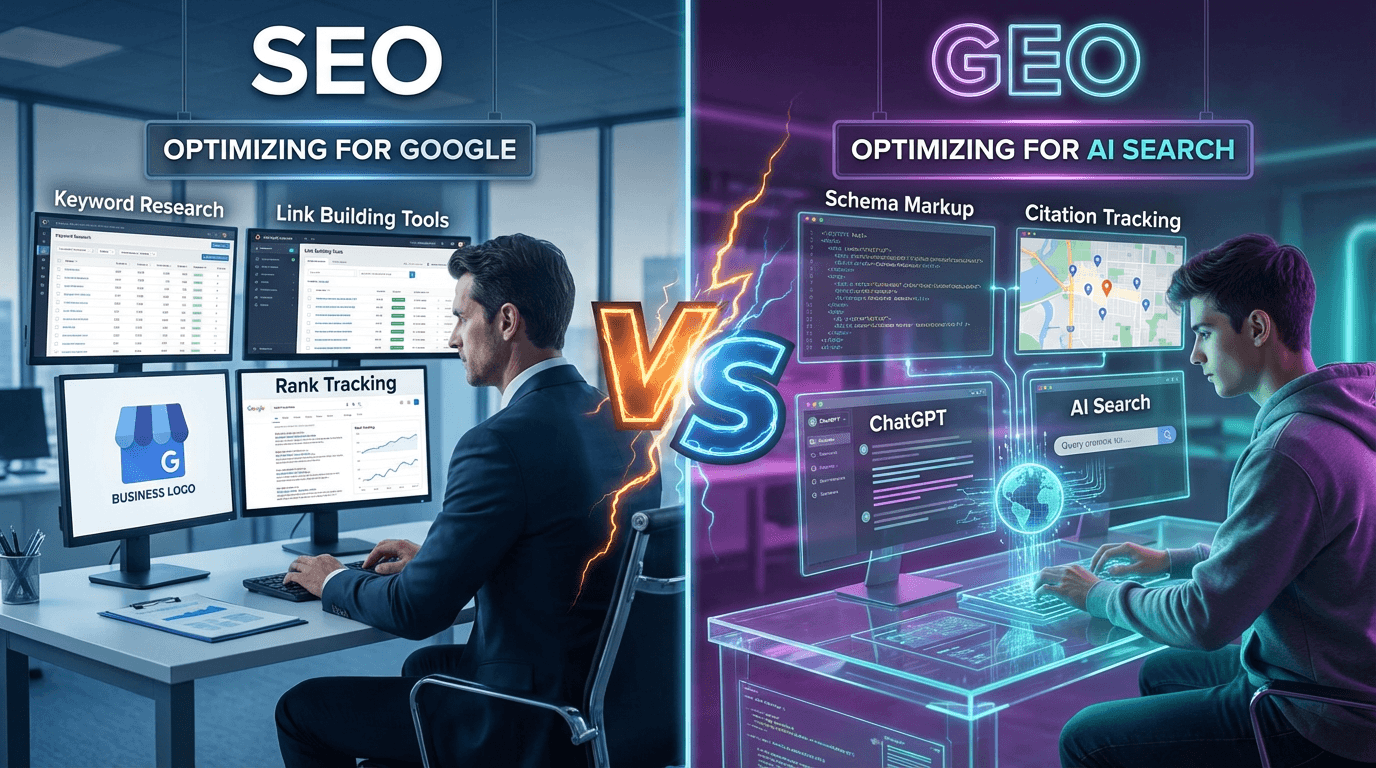
- SEO optimizes for Google rankings; GEO optimizes for AI citations
- GEO focuses on answer extraction while SEO focuses on click-through
- Both strategies are complementary, not mutually exclusive
- Businesses should invest in both for comprehensive search visibility
- GEO is essential as AI search usage grows 400% year-over-year
GEO vs SEO: Understanding the Key Differences
Last updated: January 2026If you've been doing SEO for years, you might be wondering: Do I really need GEO too? The answer is yes, and understanding why requires understanding how these strategies differ fundamentally.
What is SEO?
Search Engine Optimization (SEO) is the practice of optimizing your website to rank higher in search engine results pages (SERPs). Traditional SEO focuses on:- Keyword optimization
- Backlink building
- Technical site health
- Content quality and relevance
- User experience signals
The goal: Get your website to appear when users search on Google, Bing, or other traditional search engines.
What is GEO?
Generative Engine Optimization (GEO) is the practice of optimizing your content to be cited by AI-powered systems. GEO focuses on:- Answer-ready content structure
- Schema markup implementation
- Entity clarity and authority signals
- FAQ optimization
- Factual accuracy and sourcing
The goal: Get your business mentioned when users ask AI assistants for recommendations or information.
Side-by-Side Comparison
| Factor | Traditional SEO | GEO Optimization |
|---|---|---|
| Primary Goal | Rank in search results | Get cited by AI systems |
| Target Platforms | Google, Bing, Yahoo | ChatGPT, Claude, Perplexity, Google AI |
| Success Metric | Rankings, organic traffic | AI citations, brand mentions |
| Content Format | Keyword-optimized pages | Answer-ready, structured content |
| Technical Focus | Speed, mobile, Core Web Vitals | Schema, entity clarity, structured data |
| Timeline | 3-12 months for results | 4-8 weeks for visibility changes |
| Competition | High (20+ years of SEO) | Low (GEO is still emerging) |
Why Both Matter in 2026
The Search Landscape is Fragmenting
Users no longer rely solely on Google. They:
- Ask ChatGPT for recommendations
- Use Perplexity for research
- Get answers from Claude
- See Google AI Overviews
AI Search is Growing Exponentially
Consider these trends:
- AI search usage growing 400% year-over-year
- 40% of Gen Z prefers AI chatbots over Google
- 65% of Google searches result in zero clicks (AI Overviews)
- Perplexity reached 100M+ monthly users in 2025
The Winner Takes Most
In AI search, there's no "page 2." When someone asks ChatGPT for a recommendation, it typically mentions 3-5 businesses. If you're not one of them, you're invisible, there's no scrolling to find you.
How SEO and GEO Work Together
The good news: Many SEO fundamentals support GEO. Here's how they align:
Complementary Practices
- Quality Content
- Technical Foundation
- Authority Building
Where They Diverge
- Content Structure
- FAQ Strategy
- Success Measurement
Should You Prioritize GEO or SEO?
Prioritize SEO If:
- Your business relies heavily on organic search traffic
- You're in a competitive industry with established SEO
- Your customers primarily use traditional search
- You have an existing SEO strategy performing well
Prioritize GEO If:
- You're targeting younger demographics (AI-native users)
- Your industry involves high-consideration decisions
- You want first-mover advantage in AI search
- Traditional SEO is highly competitive in your space
Best Approach: Do Both
For most businesses, the answer is both. Here's a suggested allocation:
- Established businesses: 60% SEO, 40% GEO
- New businesses: 50% SEO, 50% GEO
- Tech/B2B businesses: 40% SEO, 60% GEO
- Local services: 50% SEO, 50% GEO
Getting Started with GEO
If you've been focusing on SEO, here's how to add GEO to your strategy:
Step 1: Audit Your AI Visibility
Test your visibility across major AI platforms. Ask ChatGPT, Claude, and Perplexity about your industry and see if you're mentioned.
Step 2: Implement Schema Markup
Add structured data to help AI systems understand your content:
- Organization schema
- FAQ schema
- Product/Service schema
- Local Business schema (if applicable)
Step 3: Restructure Content for AI
Transform existing content to be more AI-friendly:
- Add clear Q&A sections
- Include direct answers to common questions
- Structure information for easy extraction
Step 4: Build Authority Signals
Help AI systems recognize your expertise:
- Create comprehensive resource content
- Get cited by authoritative sources
- Maintain consistent brand information across the web
The Future of Search Optimization
By 2027, experts predict:
- Traditional organic search traffic will decline 25%
- AI-assisted searches will exceed 50% of all queries
- Businesses without GEO will lose significant visibility
Conclusion
GEO and SEO are complementary strategies for the modern search landscape. While SEO remains important for traditional search visibility, GEO is essential for the rapidly growing AI search channel.
Don't think of it as GEO vs SEO, think of it as GEO AND SEO working together for comprehensive search visibility.
---
Ready to add GEO to your strategy? Get a free AI visibility audit and see exactly where you stand in AI search results.Want to see your AI visibility score?
Get a free GEO audit and discover exactly what's holding your site back in AI search, in 90 seconds.
Start Free AuditFrequently Asked Questions
What is the main difference between GEO and SEO?
The main difference is their goal: SEO aims to rank your website in traditional search results (like Google's blue links), while GEO aims to get your content cited by AI systems like ChatGPT, Claude, and Perplexity when they answer user questions.
Do I need GEO if I already do SEO?
Yes. While good SEO provides a foundation, it doesn't guarantee AI visibility. AI systems use different criteria to decide what content to cite. With 40%+ of searches now involving AI, GEO is essential for comprehensive visibility.
Will GEO replace SEO?
No. GEO complements SEO rather than replacing it. Traditional search isn't going away, but AI search is growing rapidly. Smart businesses invest in both strategies to maximize visibility across all search channels.
Which is more important: GEO or SEO?
Both are important. SEO still drives significant traffic from traditional search. However, GEO is increasingly critical as more users turn to AI for recommendations. The ideal strategy addresses both.
Can I do GEO myself or do I need an expert?
Basic GEO principles can be implemented yourself: structured content, FAQ optimization, and schema markup. However, comprehensive GEO strategy benefits from expert analysis of how AI systems process your specific content and industry.
Cited Team
AI Search Optimization Experts
The Cited team builds and runs a 120+ factor audit engine for AI search visibility. Our experts combine deep technical knowledge with practical experience helping businesses get found by ChatGPT, Claude, Perplexity, and other AI assistants.
Topics
Ready to Optimize Your Site for AI Search?
Get a free GEO audit and see your optimization score in 90 seconds.
Start Free Audit