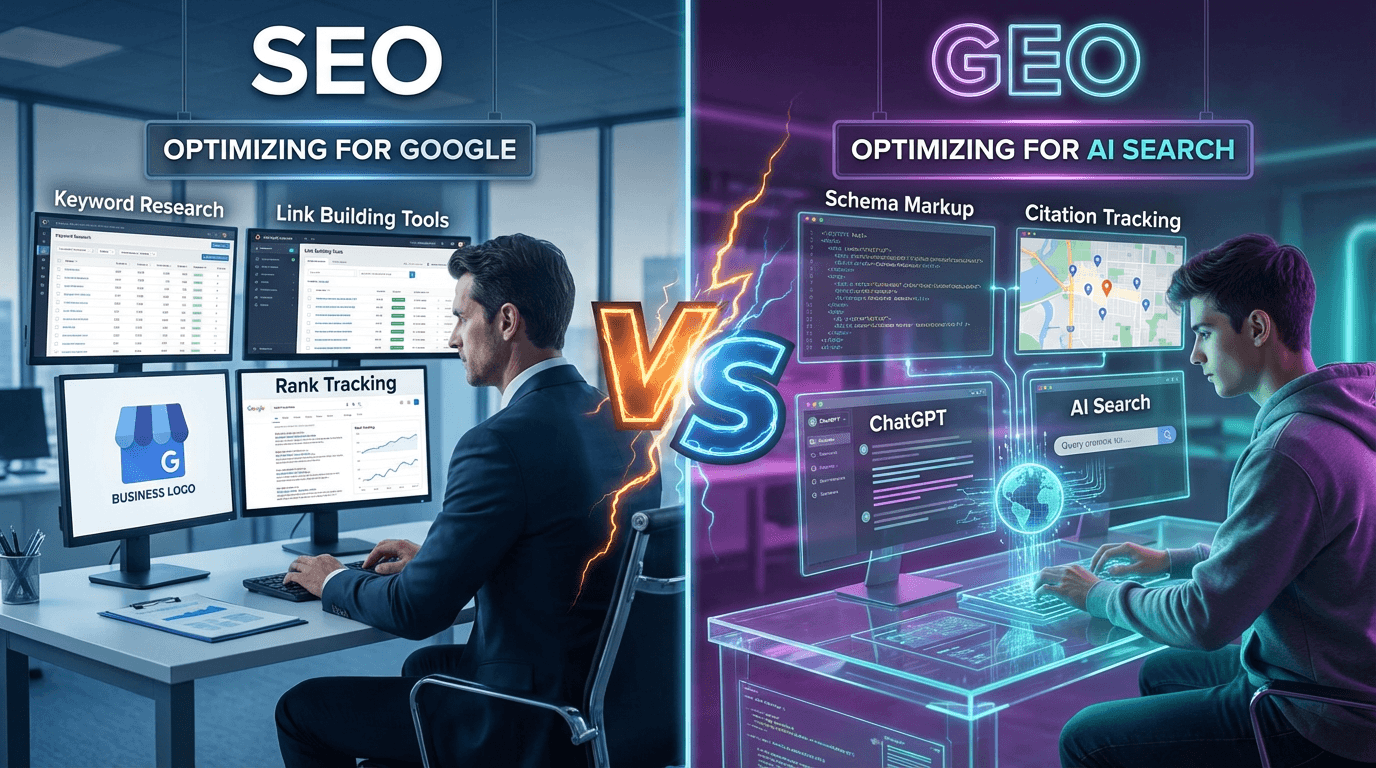
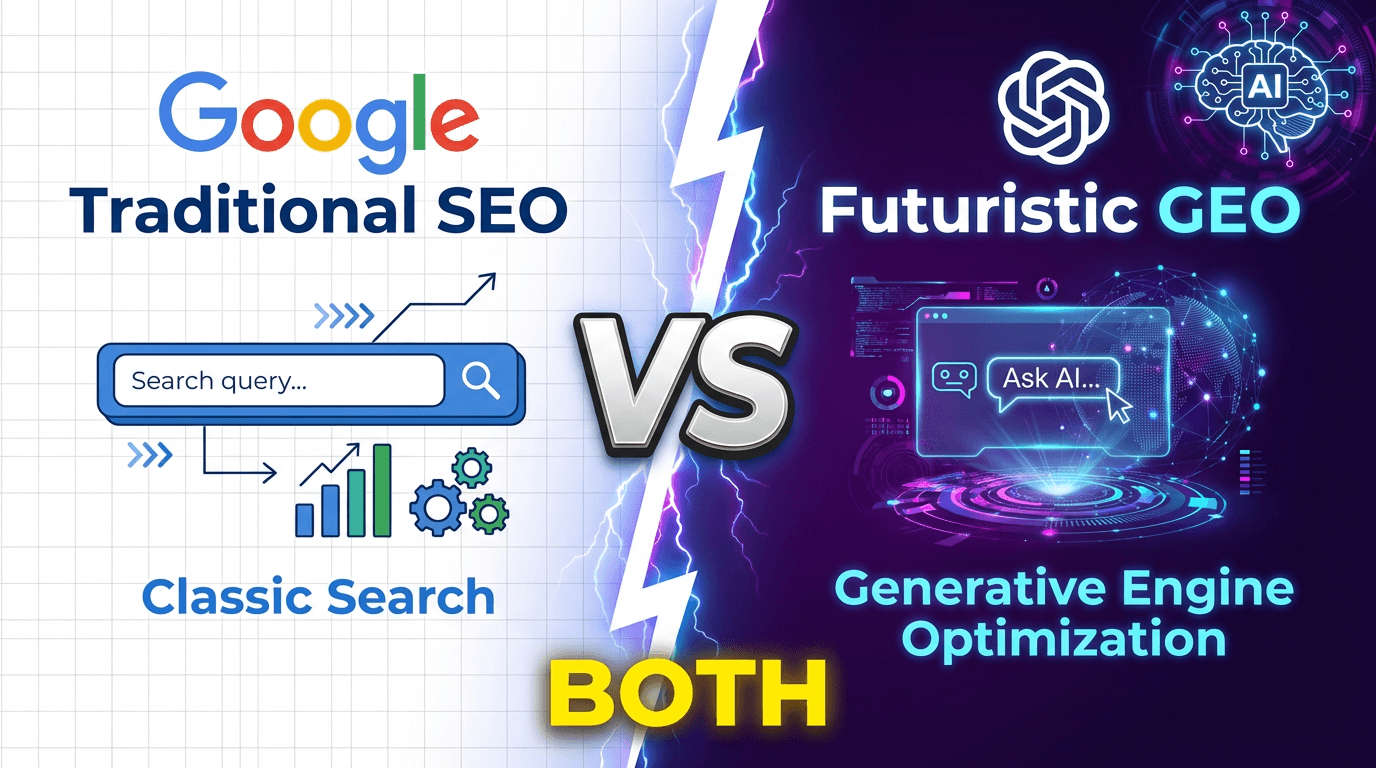
GEO vs SEO: What's the Difference and Why You Need Both in 2026
A detailed comparison of GEO (Generative Engine Optimization) and traditional SEO in 2026. Understand where they overlap, where they diverge, and why a combined strategy delivers the best results.
This article is part of our The Complete Guide to GEO Optimization in 2026 series.
Articles in this series (2 of 7):
Key Takeaways
- SEO optimizes for traditional search rankings; GEO optimizes for AI-generated citations. Both are essential in 2026.
- SEO and GEO share about 50-60% of their foundation: quality content, technical health, schema markup, and E-E-A-T signals.
- They diverge in content structure (scanning vs. extraction), authority signals (backlinks vs. entity recognition), and measurement approaches.
- A combined SEO + GEO strategy costs roughly 30-40% more than SEO alone but delivers visibility across double the search surfaces.
- Schema markup is the highest-leverage activity for GEO that also benefits SEO -- implement it first.
- Most competitors are still doing SEO only, creating a first-mover advantage for businesses that add GEO now.
GEO vs SEO: The Definitive 2026 Comparison
Last updated: February 2026 Quick answer: SEO (Search Engine Optimization) optimizes your website to rank in traditional search engine results like Google and Bing. GEO (Generative Engine Optimization) optimizes your website to be cited by AI-powered assistants like ChatGPT, Claude, Perplexity, and Google Gemini. In 2026, you need both because your audience is split across both channels -- and the split is accelerating.---
What Is SEO?
Search Engine Optimization (SEO) has been the dominant digital marketing discipline for over 25 years. It encompasses the strategies and techniques used to improve your website's visibility in traditional search engine results pages (SERPs). Core SEO activities include:- Keyword research and targeting: Identifying the terms your audience searches for and weaving them into your content.
- On-page optimization: Crafting title tags, meta descriptions, headers, and body copy to match search intent.
- Technical SEO: Ensuring fast page speed, mobile responsiveness, clean URL structures, and crawlability.
- Link building: Earning backlinks from authoritative websites to boost domain authority.
- Content creation: Publishing valuable, in-depth content that satisfies user queries.
SEO's goal is simple: rank as high as possible in Google's organic results so that users click through to your website.
---
What Is GEO?
Generative Engine Optimization (GEO) is the newer discipline focused on getting your website and brand cited in AI-generated responses. When a user asks ChatGPT a question about your industry, GEO determines whether your content appears in the answer. Core GEO activities include:- Schema markup implementation: Adding JSON-LD structured data (Organization, FAQPage, Article, Product) so AI systems can understand your content programmatically.
- Content structuring for extraction: Using question-based headings, cite-worthy sentences, and focused paragraphs that AI can easily parse and quote.
- FAQ optimization: Creating comprehensive Q&A sections with FAQPage schema that directly answer the questions users ask AI assistants.
- E-E-A-T signal strengthening: Building trust through author credentials, source citations, and consistent brand signals.
- AI crawler access: Configuring robots.txt to allow GPTBot, ClaudeBot, anthropic-ai, and PerplexityBot to crawl your site.
GEO's goal is different from SEO's: get cited as a source in AI-generated answers so that users trust and engage with your brand.
---
Side-by-Side Comparison Table
| Dimension | Traditional SEO | GEO Optimization |
|---|---|---|
| Primary goal | Rank on page 1 of Google | Get cited in AI-generated answers |
| Target system | Google, Bing, Yahoo | ChatGPT, Claude, Perplexity, Gemini |
| Content format | Keyword-targeted articles and pages | Structured, cite-worthy, FAQ-rich content |
| Technical priority | Meta tags, Core Web Vitals, backlinks | Schema markup, entity clarity, AI bot access |
| Success metric | Rankings, organic traffic, CTR | AI citations, brand mentions, referral traffic |
| Competition model | 10 organic spots per SERP page | Unlimited citation opportunities per query |
| Time to results | 3-12 months for meaningful impact | 2-8 weeks for initial citations |
| User experience | User clicks a link and visits your site | AI quotes your content directly in its response |
| Primary trust signal | Domain authority via backlinks | E-E-A-T and schema completeness |
| Content length | Varies; often 1,000-3,000 words | Depth matters more; comprehensive coverage preferred |
---
Where SEO and GEO Overlap
Despite their different targets, SEO and GEO share a significant common foundation. This overlap is good news because work you do for one benefits the other.
1. Quality Content Is Non-Negotiable
Both Google and AI systems reward content that is comprehensive, accurate, and genuinely useful. Thin, shallow content fails in both channels. Investing in high-quality content pays dividends for SEO and GEO simultaneously.
2. Technical Health Matters
A slow website with broken links, missing HTTPS, and poor mobile experience performs badly in both traditional and AI search. Core Web Vitals improvements benefit your Google rankings and your AI crawlability.
3. E-E-A-T Is a Shared Trust Framework
Google explicitly uses E-E-A-T (Experience, Expertise, Authoritativeness, Trustworthiness) as a ranking factor. AI systems use similar trust signals when selecting sources to cite. Author bios, credentials, source citations, and brand consistency matter everywhere.
4. Structured Data Helps Both
Schema markup (JSON-LD) helps Google generate rich snippets and helps AI systems extract structured information. FAQPage schema, for example, can win you both a Google FAQ rich result and an AI citation.
5. User Intent Alignment
Both SEO and GEO succeed when your content genuinely answers the questions your audience is asking. Intent research is foundational to both strategies.
---
Where SEO and GEO Diverge
While the foundation is shared, the execution differs in important ways.
Content Structure Philosophy
SEO content is optimized for human scanning:- Attention-grabbing headlines
- Skimmable bullet points
- Strategic keyword placement in the first 100 words
- Internal links distributed throughout
- Question-based headings that match AI queries
- Cite-worthy standalone sentences that can be quoted verbatim
- Answer-first paragraph structure (lead with the fact, then explain)
- Focused paragraphs covering one idea each
Link Strategy
SEO places enormous emphasis on backlinks. Domain authority, referring domains, and link quality are primary ranking factors. Link building campaigns are a core SEO activity. GEO cares less about backlinks per se and more about brand signals and entity recognition across the web. AI systems assess your authority by whether your brand is consistently mentioned as an expert source across multiple contexts, not just by counting links.Keyword vs. Entity Focus
SEO revolves around keywords -- specific terms users type into Google. Keyword research, keyword density, and keyword placement drive SEO strategy. GEO revolves around entities -- the concepts, brands, products, and relationships that AI systems model internally. Entity clarity (making it unambiguous what your brand is, what you do, and who you serve) is more important than targeting specific keyword phrases.Measurement Approach
SEO metrics are well-established: rankings, organic traffic, click-through rate, conversion rate. Tools like Google Search Console, Ahrefs, and SEMrush provide detailed tracking. GEO metrics are newer and less standardized: AI citation frequency, brand mention tracking, GEO score trends, and manual citation testing across multiple AI platforms. The measurement ecosystem is maturing rapidly. Run a free GEO audit to establish your baseline.---
Why You Need Both in 2026
The Search Landscape Is Split
In 2026, users search through multiple channels:
- Traditional Google search still handles billions of queries daily.
- ChatGPT is the default research tool for over 250 million weekly users.
- Perplexity is the fastest-growing search platform.
- Google AI Overviews blend traditional results with AI-generated answers.
- Claude, Gemini, and Copilot are gaining significant market share.
If you only optimize for SEO, you miss the AI channel. If you only optimize for GEO, you miss traditional search. A combined strategy ensures maximum visibility across all search surfaces.
They Reinforce Each Other
The best part of a dual strategy is that SEO and GEO improvements are largely synergistic:
- Schema markup boosts Google rich results (SEO) and AI extraction (GEO).
- FAQ content wins featured snippets (SEO) and AI citations (GEO).
- E-E-A-T signals improve Google rankings (SEO) and AI source selection (GEO).
- Fast, accessible sites rank better on Google (SEO) and get crawled more effectively by AI bots (GEO).
The effort overlap means that a combined strategy costs perhaps 30-40% more than SEO alone, but delivers visibility across double the search surfaces.
The Cost of Ignoring Either
- Ignoring SEO: You lose billions of daily Google searches, especially navigational and transactional queries.
- Ignoring GEO: You lose the fastest-growing search channel, especially informational and research-stage queries where AI assistants excel.
Neither sacrifice is wise when the optimization overlap makes a combined approach so efficient.
---
How to Build a Combined SEO + GEO Strategy
Step 1: Audit Both Channels
Start with a traditional SEO audit (technical health, rankings, backlink profile) and a GEO audit (schema, content structure, FAQ coverage, E-E-A-T signals). Identify the gaps in each.
Step 2: Fix Shared Foundation Issues First
Address technical issues that affect both channels: page speed, mobile experience, HTTPS, broken links, and crawlability (including AI bot access in robots.txt).
Step 3: Implement Schema Markup
Schema is the highest-leverage activity for GEO that also benefits SEO. Prioritize Organization, FAQPage, Article, and Product/Service schema across your site.
Step 4: Optimize Content for Both Audiences
When writing or restructuring content, follow these guidelines:
- Use question-based headings (GEO) that also contain target keywords (SEO).
- Lead each section with a direct answer (GEO) and elaborate with depth (SEO).
- Add FAQ sections with schema to key pages (both).
- Write cite-worthy summary sentences (GEO) in naturally keyword-rich language (SEO).
Step 5: Build Authority in Both Channels
- Earn backlinks from authoritative sites (SEO) that also strengthen your brand entity recognition (GEO).
- Publish comprehensive, expert-authored content that demonstrates E-E-A-T (both).
- Maintain consistent brand signals (NAP data, social profiles, directory listings) across the web (both).
Step 6: Monitor and Iterate
Track SEO metrics (rankings, traffic, CTR) and GEO metrics (AI citations, GEO score, brand mentions) separately but review them together. Look for patterns: when your GEO score improves, does your featured snippet win rate also increase?
Visit our pricing page to explore combined SEO + GEO optimization plans, or start with a free GEO audit to understand your current standing.
---
The Bottom Line
SEO and GEO are not competitors -- they are partners. SEO captures traditional search traffic while GEO captures AI-generated citations. The businesses that invest in both will dominate their industries' search visibility in 2026 and beyond.
The strategic advantage belongs to those who recognize this early. Most businesses are still doing SEO alone. By adding GEO now, you get ahead of the curve while the competition is still catching up.
Start today: Run a free GEO audit and compare your AI visibility to your traditional search performance. The gaps you find are your biggest opportunities.Want to see your AI visibility score?
Get a free GEO audit and discover exactly what's holding your site back in AI search, in 90 seconds.
Start Free AuditFrequently Asked Questions
Can GEO replace SEO entirely?
No. GEO and SEO serve different search channels. SEO captures traditional Google search traffic, while GEO captures AI-generated citations from ChatGPT, Claude, and Perplexity. In 2026, you need both for maximum visibility because your audience is split across both channels.
Which should I invest in first: SEO or GEO?
If you already have a basic SEO foundation (indexed pages, reasonable site speed, some content), start adding GEO on top of it. If your site has critical technical issues, fix those first since they affect both channels. For most businesses, the most efficient approach is a combined strategy from the start.
How much of SEO and GEO work overlaps?
Roughly 50-60% of the work overlaps. Quality content, technical health, schema markup, E-E-A-T signals, and FAQ sections benefit both SEO and GEO. The unique GEO work involves AI-specific content structuring, entity optimization, and AI crawler configuration.
Is GEO just SEO with schema markup added?
No. While schema markup is a critical component, GEO also involves restructuring content for AI extraction, writing cite-worthy sentences, optimizing for entity clarity over keyword density, ensuring AI bot crawler access, and strengthening trust signals specifically for AI source selection algorithms.
How do I measure GEO success compared to SEO success?
SEO success is measured through rankings, organic traffic, and click-through rates using tools like Google Search Console. GEO success is measured through AI citation frequency, brand mentions in AI responses, GEO audit scores, and manual citation testing across ChatGPT, Claude, and Perplexity.
Cited Team
AI Search Optimization Experts
The Cited team builds and runs a 120+ factor audit engine for AI search visibility. Our experts combine deep technical knowledge with practical experience helping businesses get found by ChatGPT, Claude, Perplexity, and other AI assistants.
Topics
Ready to Optimize Your Site for AI Search?
Get a free GEO audit and see your optimization score in 90 seconds.
Start Free Audit