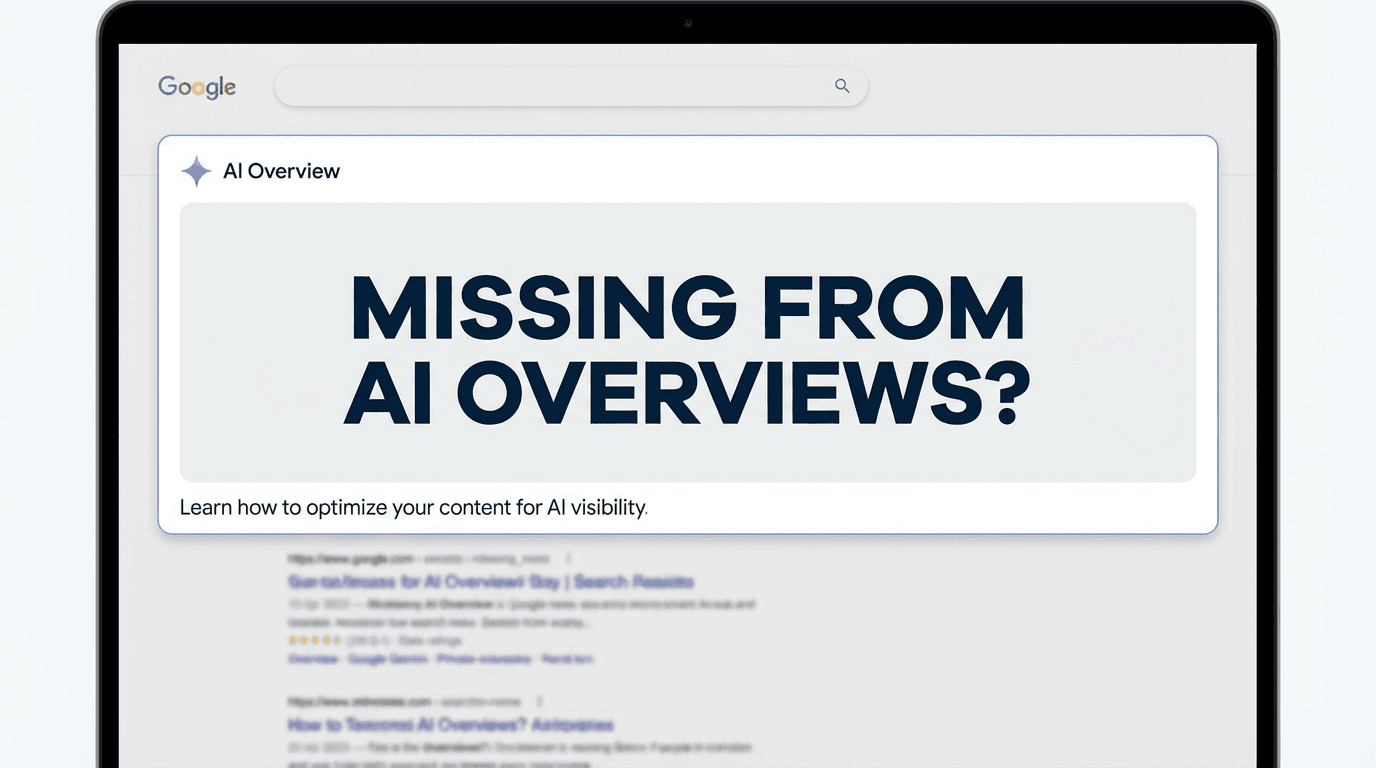
Google AI Overviews: Why You're Not Appearing (And How to Fix It)
Learn how Google AI Overviews selects sources and the specific optimizations needed to get your content featured in Google's AI-generated answers.
This article is part of our Perplexity SEO: How to Get Cited series.
Articles in this series (2 of 4):
Key Takeaways
- Google AI Overviews appear for 65%+ of informational queries and push traditional results down
- E-E-A-T signals (expertise, authority, trust) are critical for AI Overview inclusion
- Content must provide direct, extractable answers to specific questions
- Schema markup helps Google's AI understand and cite your content accurately
- Technical performance (Core Web Vitals, mobile, speed) affects AI Overview selection
What Are Google AI Overviews?
Google AI Overviews (formerly SGE - Search Generative Experience) are AI-generated summaries that appear at the top of Google search results. Instead of showing just links, Google now synthesizes information from multiple sources and presents a direct answer.
Why this matters for your business:- AI Overviews appear for 65%+ of informational queries
- They push traditional results below the fold
- Getting cited in overviews drives significant visibility
- Most websites are NOT optimized for this new format
If you're not appearing in Google AI Overviews, you're losing visibility even if you rank well traditionally.
How Google AI Overviews Select Sources
Google's AI pulls information from websites it trusts. The selection criteria include:
1. E-E-A-T Signals (Experience, Expertise, Authority, Trust)
- Author credentials and expertise
- Website reputation and history
- Citations from other authoritative sources
- Clear organizational identity
2. Content Relevance and Quality
- Direct answers to the user's question
- Comprehensive topic coverage
- Current, recently-updated information
- Factual accuracy
3. Structured Data
- Schema markup implementation
- Clear content organization
- FAQ and How-To structured content
- Proper heading hierarchy
4. Traditional SEO Factors
- Page speed and Core Web Vitals
- Mobile-friendliness
- Secure connection (HTTPS)
- Domain authority
Why You're Not Appearing in AI Overviews
Reason #1: Weak E-E-A-T Signals
Google's AI heavily weights trustworthiness. If your site lacks:
- Clear author information
- Company credentials
- Expert testimonials
- Industry recognition
...you're unlikely to be cited regardless of content quality.
Fix: Add author bios, company history, credentials, certifications, and testimonials throughout your site.Reason #2: Content Doesn't Answer Questions Directly
AI Overviews need extractable answers. If your content:
- Buries answers in long paragraphs
- Uses vague marketing language
- Lacks specific data or facts
- Doesn't address the actual question
...Google's AI will skip it.
Fix: Restructure content with question-based headings and direct answers in the first sentence of each section.Reason #3: Missing or Incomplete Schema
Schema markup helps Google's AI understand your content. Common gaps:
- No Organization schema
- No FAQ schema on Q&A content
- No Article schema on blog posts
- Missing author and date information
Reason #4: Outdated Content
Google's AI prefers fresh information. Content without:
- Visible publish dates
- Recent update timestamps
- Current year references
- Updated statistics
...signals staleness.
Fix: Add dates to all content and update important pages quarterly.Reason #5: Poor Page Experience
Technical issues affect AI Overview inclusion:
- Slow page load times
- Mobile usability problems
- Intrusive interstitials
- Poor Core Web Vitals
How to Optimize for Google AI Overviews
Step 1: Audit Your Current Status
Check if you're appearing in AI Overviews:
- Search for questions your content answers
- Look for the AI Overview box at the top
- See if your site is cited as a source
- Note which competitors appear
Step 2: Strengthen E-E-A-T Signals
Add to every page:
- Author name and credentials
- Company information
- Publication and update dates
- Sources for claims and statistics
Step 3: Restructure for AI Extraction
Format content for easy extraction:
## What is [topic]?
[Topic] is [direct 1-sentence definition]. It involves [brief explanation]
and is important because [why it matters].
Key characteristics include:
- Point 1
- Point 2
- Point 3
Step 4: Implement Schema Markup
Essential schemas for AI Overviews:
- Organization (every page)
- Article (blog posts)
- FAQPage (Q&A content)
- HowTo (instructional content)
- Author (linked to articles)
Step 5: Create "Overview-Worthy" Content
Content that gets featured typically:
- Answers specific questions directly
- Provides unique data or insights
- Includes step-by-step instructions
- Covers topics comprehensively
- Uses clear, simple language
Google AI Overview Optimization Checklist
- [ ] Author information on all content
- [ ] Organization schema site-wide
- [ ] FAQ schema where applicable
- [ ] Question-based H2 headings
- [ ] Direct answers in first sentences
- [ ] Publish and update dates visible
- [ ] Core Web Vitals passing
- [ ] Mobile-friendly design
- [ ] HTTPS enabled
- [ ] Specific data and statistics
Track Your Progress
Monitor AI Overview visibility:
- Search for your target queries regularly
- Note which sources Google cites
- Track changes after optimization
- Compare performance to competitors
Run a free GEO audit to see how well your site is optimized for Google AI Overviews and other AI search engines.
Want to see your AI visibility score?
Get a free GEO audit and discover exactly what's holding your site back in AI search, in 90 seconds.
Start Free AuditFrequently Asked Questions
Are Google AI Overviews the same as featured snippets?
No, they're different. Featured snippets extract content from a single source. AI Overviews synthesize information from multiple sources to create an original answer. Optimizing for both requires similar strategies, but AI Overviews consider more factors including E-E-A-T signals.
Can I opt out of Google AI Overviews?
You can prevent your content from being used in AI Overviews using the 'nosnippet' meta tag or X-Robots-Tag header. However, this also prevents traditional featured snippets and may reduce overall visibility. Most businesses benefit more from optimizing for inclusion.
How long until I appear in AI Overviews after optimizing?
Changes can be reflected within 2-4 weeks as Google recrawls and reprocesses your content. However, building E-E-A-T signals is a longer-term process. Expect gradual improvement over 2-3 months with consistent optimization.
Do AI Overviews affect click-through rates?
AI Overviews can reduce clicks for simple informational queries since users get answers directly. However, being cited as a source still drives qualified traffic, and for complex queries, users often click through for more detail. The key is being cited rather than ignored.
Cited Team
AI Search Optimization Experts
The Cited team builds and runs a 120+ factor audit engine for AI search visibility. Our experts combine deep technical knowledge with practical experience helping businesses get found by ChatGPT, Claude, Perplexity, and other AI assistants.
Topics
Ready to Optimize Your Site for AI Search?
Get a free GEO audit and see your optimization score in 90 seconds.
Start Free Audit