GEO vs SEO: What is the Difference and Why You Need Both
Understand the key differences between GEO (Generative Engine Optimization) and traditional SEO. Learn why modern businesses need both strategies to maximize visibility.
This article is part of our The Complete Guide to GEO Optimization in 2026 series.
Articles in this series (2 of 7):
Key Takeaways
- SEO optimizes for search engine rankings; GEO optimizes for AI assistant citations
- You need both strategies—they complement each other, not compete
- Many optimizations (schema, FAQs, quality content) benefit both channels
- GEO typically shows faster results (2-4 weeks) than traditional SEO (3-6 months)
- The best approach is an integrated strategy optimizing for SEO, GEO, and AEO together
- Technical foundation (speed, mobile, crawlability) matters for both
The Fundamental Difference
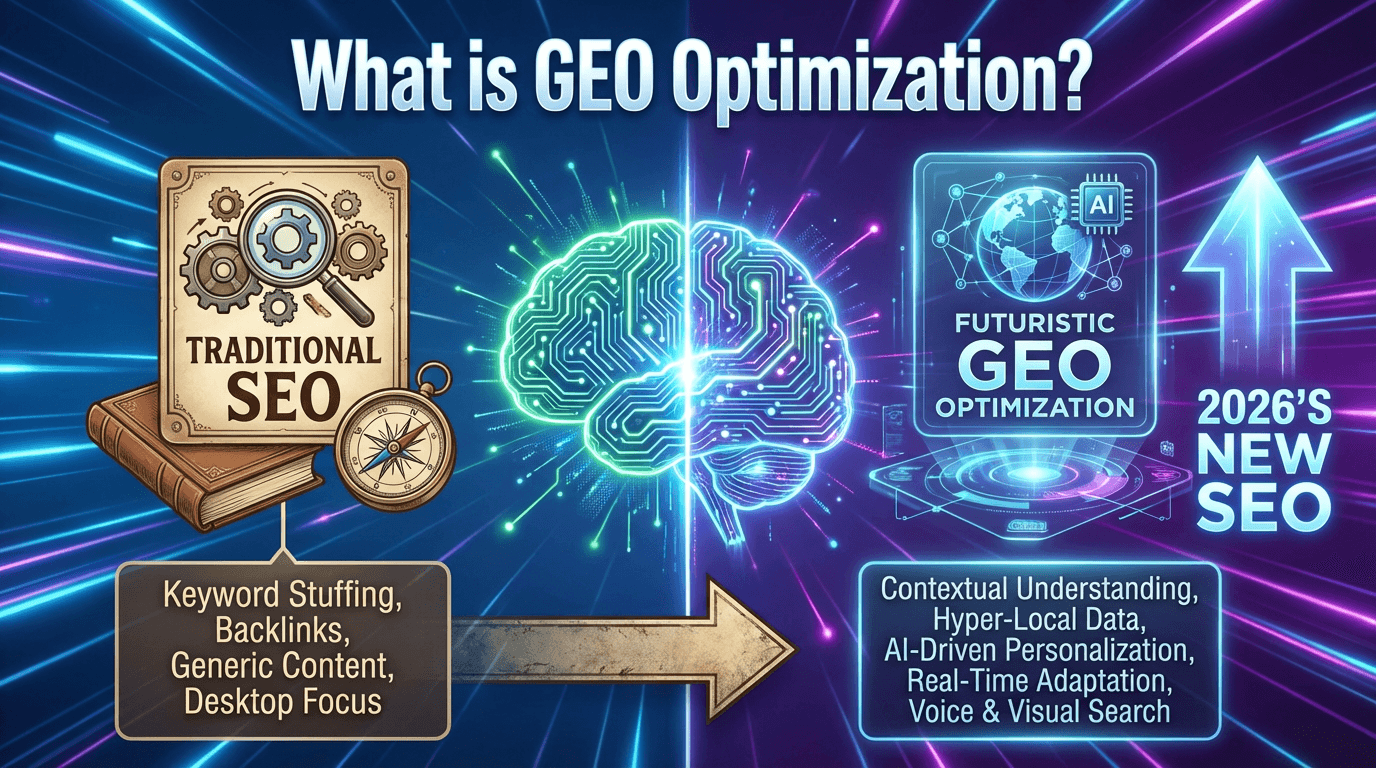
SEO (Search Engine Optimization) has been the standard for 25+ years. It focuses on ranking your website in Google search results through keywords, backlinks, and technical optimization. GEO (Generative Engine Optimization) is the new discipline focused on getting your content cited when users ask AI assistants questions. Instead of ranking number one on Google, you want to be the source ChatGPT quotes when answering queries.Think of it this way:
- SEO: "How do I get to page 1 of Google?"
- GEO: "How do I get ChatGPT to recommend my business?"
Side-by-Side Comparison
| Aspect | Traditional SEO | GEO Optimization |
|---|---|---|
| Primary Goal | Rank number one in search results | Get cited in AI responses |
| Content Format | Keyword-optimized | Question-answer format |
| Structure | Headers for human scanning | Structured for AI extraction |
| Technical Focus | Meta tags, backlinks, speed | Schema markup, entity clarity |
| Success Metric | Rankings, organic traffic | AI citations, brand mentions |
| Time to Results | 3-6 months typically | 2-4 weeks for initial impact |
| Competition | Fighting for 10 spots | Unlimited citation opportunities |
| User Intent | Searcher clicks through | AI provides direct answer |
Despite their differences, SEO and GEO share important foundations:
Quality Content
Both require valuable, comprehensive content. AI systems will not cite thin content, and Google will not rank it.Technical Foundation
Page speed, mobile optimization, and crawlability matter for both. A slow, broken site fails in both channels.E-E-A-T Signals
Experience, Expertise, Authoritativeness, and Trustworthiness are ranking factors for Google AND selection criteria for AI citations.User Intent
Both strategies succeed when they genuinely help users find answers to their questions.Where They Differ
Content Structure
SEO content is optimized for human scanning:- Headlines grab attention
- Content flows narratively
- Keywords strategically placed
- Calls-to-action throughout
- Answers appear first
- Questions used as headings
- Cite-worthy standalone sentences
- FAQ sections with schema
Technical Implementation
SEO technical focus:- Meta titles and descriptions
- Header hierarchy (H1, H2, H3)
- Internal linking
- Backlink acquisition
- Core Web Vitals
- Schema markup (especially FAQ)
- Entity relationships
- Structured data validation
- AI crawler access
- Content machine-readability
Success Measurement
SEO metrics:- Keyword rankings
- Organic traffic
- Click-through rate
- Bounce rate
- Conversions from organic
- AI citation frequency
- Brand mention in AI responses
- GEO audit score
- Featured snippet appearances
- Voice search visibility
Why You Need Both (Not Either/Or)
Some argue GEO will replace SEO. This misses the point. Here is why you need both:
Different User Behaviors
Traditional searchers still exist. Millions of people search Google daily and click through to websites. Abandoning SEO means losing this traffic. AI searchers are growing rapidly. 40%+ of Gen Z prefers AI assistants. Ignoring GEO means missing this audience.Complementary Strategies
Good GEO actually improves SEO:
- Schema markup helps Google understand your content
- FAQ sections create featured snippet opportunities
- Clear structure improves user experience signals
Good SEO supports GEO:
- Authority signals help AI trust your content
- Rankings indicate content quality
- Technical health enables AI crawling
Risk Mitigation
Depending entirely on either channel is risky:
- Google algorithm updates can tank SEO traffic overnight
- AI systems may change how they select sources
- Diversification protects your visibility
The Optimal Strategy: SEO + GEO + AEO
The most successful websites in 2026 optimize for all three:
- SEO - Foundation for traditional search visibility
- GEO - Optimization for AI assistant citations
- AEO - Answer Engine Optimization for featured snippets and voice search
These strategies work together:
- FAQ content (GEO) creates featured snippet opportunities (AEO)
- Strong rankings (SEO) signal authority to AI systems (GEO)
- Schema markup (GEO) helps Google understand content (SEO)
How to Prioritize
If You Are Starting Fresh
Start with GEO. It is faster to see results, and the optimizations benefit both channels.
Priority order:
- Implement basic schema (Organization, FAQ)
- Create FAQ-rich content
- Build traditional SEO foundation
- Expand and optimize continuously
If You Have Strong SEO
Add GEO optimization on top:
- Audit current GEO score
- Add schema markup to existing content
- Restructure top pages for AI extraction
- Create dedicated FAQ sections
If Traffic is Declining
This often indicates SEO reliance without GEO:
- Run a comprehensive audit
- Check if competitors are GEO-optimized
- Implement GEO while maintaining SEO
- Diversify traffic sources
Practical Implementation
Step 1: Audit Both
- Run an SEO audit (Semrush, Ahrefs, etc.)
- Run a GEO audit (our free tool)
- Identify overlapping opportunities
Step 2: Fix Technical Issues
Address issues that affect both:
- Page speed
- Mobile responsiveness
- Crawlability
- Site structure
Step 3: Implement Schema
Add structured data that helps both channels:
- Organization schema
- FAQ schema
- Article schema
- Product/Service schema
Step 4: Optimize Content
Update top pages for both:
- Clear keyword targeting (SEO)
- Question-based structure (GEO)
- Comprehensive answers (both)
- Internal linking (SEO)
Step 5: Monitor Both
Track performance across channels:
- Rankings and organic traffic (SEO)
- AI citations and GEO score (GEO)
- Featured snippets (AEO)
Common Mistakes
Mistake 1: Choosing One Over the Other
You need both. Do not abandon SEO for GEO or ignore GEO because SEO "still works."Mistake 2: Treating Them as Separate
The best results come from integrated strategies that optimize for both simultaneously.Mistake 3: Ignoring the Overlap
Many optimizations help both channels. Focus on these first for maximum efficiency.The Bottom Line
SEO and GEO are not competitors—they are complements.SEO gets you found when people search Google. GEO gets you cited when people ask ChatGPT. In 2026, your customers use both.
The businesses that will dominate their industries are those optimizing for both channels, creating content that serves human readers and AI systems equally well.
Start today: Run a GEO audit to see where you stand, then build a strategy that optimizes for both traditional and AI search.Frequently Asked Questions
Is GEO replacing SEO?
No, GEO is complementing SEO, not replacing it. Traditional search still drives billions of queries daily. However, AI search is growing rapidly and will likely become equally important. Smart businesses optimize for both channels rather than choosing one.
Which should I focus on first, SEO or GEO?
If starting fresh, GEO often shows faster results (2-4 weeks vs 3-6 months for SEO). However, many GEO optimizations also benefit SEO. The best approach is an integrated strategy focusing on overlapping improvements like schema markup and FAQ content first.
Can good SEO help my GEO?
Yes, significantly. Strong SEO signals indicate content quality and authority, which AI systems consider when selecting sources to cite. Technical SEO fundamentals like speed and crawlability are essential for both. A site that ranks well often gets cited by AI more frequently.
What is the biggest difference between SEO and GEO?
The fundamental difference is the output. SEO aims for rankings in a list of search results where users click through to your site. GEO aims for citations in AI-generated answers where the AI may directly quote your content. This requires different content structures and optimization approaches.
Do I need different content for SEO and GEO?
Not necessarily different content, but differently structured content. The same topic can serve both by using question-based headings (GEO), including FAQ sections with schema (GEO), maintaining keyword optimization (SEO), and building internal links (SEO). Well-structured content serves both channels.
Cited Team
AI Search Optimization Experts
The Cited team has analyzed over 10,000 websites for AI search visibility. Our experts combine deep technical knowledge with practical experience helping businesses get found by ChatGPT, Claude, Perplexity, and other AI assistants.
Topics
Ready to Optimize Your Site for AI Search?
Get a free GEO audit and see your optimization score in 90 seconds.
Start Free Audit