The Complete Guide to GEO Optimization in 2026
Master Generative Engine Optimization with this comprehensive guide. Learn how to get your website cited by ChatGPT, Claude, Perplexity, and Google AI.
This is the main guide in our Complete GEO Guide series. Explore related articles below for deeper insights.
Articles in this series (1 of 7):
Key Takeaways
- GEO optimization is essential for visibility in AI search engines like ChatGPT, Claude, and Perplexity
- The 5 pillars of GEO are: Content Structure, Schema Markup, E-E-A-T Signals, FAQ Optimization, and Technical Foundation
- FAQ schema is the single most impactful element—implement it on all key pages
- Most businesses can achieve 30+ point score improvements within 60 days
- GEO complements traditional SEO—implementing both gives you maximum visibility
- Early adopters have significant advantage as competitors have not optimized yet
- Regular audits and updates are necessary as AI systems evolve
The way people find information online has fundamentally changed. In 2026, over 40% of online searches involve AI assistants like ChatGPT, Claude, or Perplexity. If your website is not optimized for these AI systems, you are invisible to a massive and growing audience.
This comprehensive guide covers everything you need to know about GEO (Generative Engine Optimization)—from foundational concepts to advanced implementation strategies.
Part 1: Understanding GEO
What is GEO Optimization?
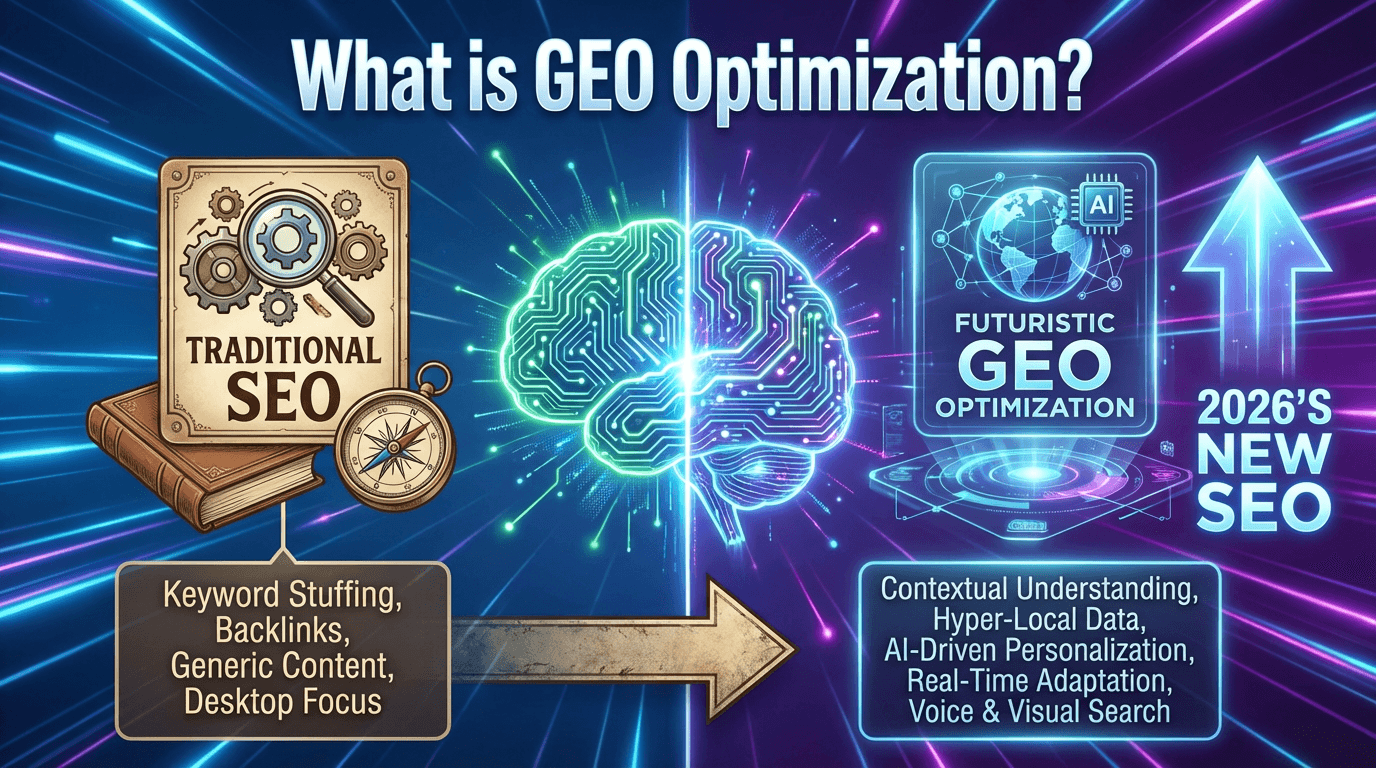
GEO (Generative Engine Optimization) is the practice of optimizing your website and content to be discovered, understood, and cited by AI-powered search systems. While traditional SEO focuses on ranking in Google's search results, GEO ensures your content appears in AI-generated responses.Think of it this way: When someone asks ChatGPT "What is the best CRM for small businesses?" or asks Perplexity "How do I optimize my website for voice search?", GEO determines whether YOUR content gets cited in the answer.
Why GEO Matters Now
The shift to AI search is not coming—it is here. Consider these statistics:
- 40% of Gen Z prefers AI chatbots over traditional search (Gartner, 2025)
- 65% of Google searches result in zero clicks due to AI Overviews
- ChatGPT has over 200 million weekly active users
- Perplexity is growing at 400%+ year-over-year
- Traditional search traffic will decline 25% by 2027 (Forrester)
The businesses that optimize for GEO now will dominate their industries as this shift accelerates. Those that wait will struggle to catch up.
The History of Search Evolution
To understand where we are going, it helps to see where we have been:
- 1990s: Directory-based search (Yahoo, DMOZ)
- 2000s: Keyword-based search (Google PageRank)
- 2010s: Semantic search (Google Hummingbird, RankBrain)
- 2020s: AI-generated answers (ChatGPT, Perplexity, Google AI Overviews)
Each evolution required new optimization strategies. GEO is the natural evolution for the AI age.
Part 2: GEO vs SEO vs AEO
Understanding the Differences
Many businesses confuse GEO with traditional SEO. Here is how they differ:
| Aspect | SEO | GEO | AEO |
|---|---|---|---|
| Goal | Rank in search results | Get cited by AI | Appear in answer boxes |
| Focus | Keywords and backlinks | Structure and clarity | Direct answers |
| Content | Optimized for scanning | Optimized for extraction | Optimized for voice |
| Technical | Meta tags, speed | Schema markup, entities | Featured snippet format |
| Metric | Rankings, traffic | AI citations | Answer appearances |
The most successful websites in 2026 optimize for all three:
- SEO ensures you are found in traditional search
- GEO ensures you are cited by AI assistants
- AEO ensures you appear in answer boxes and voice search
These strategies complement each other. Good schema markup (GEO) helps with featured snippets (AEO) and traditional rankings (SEO).
Part 3: The 5 Pillars of GEO Optimization
Pillar 1: Content Structure
AI systems do not read content like humans do. They extract information based on structure. To optimize your content structure:
Start with the answer. Do not bury your main point. AI systems often extract the first sentence that answers a query. Use question-based headings. Instead of "Our Services," use "What Services Do We Offer?" This matches how users query AI assistants. Create cite-worthy sentences. Write standalone sentences that can be quoted directly. Example: "GEO optimization increases AI visibility by an average of 78% within 60 days." Keep paragraphs focused. Each paragraph should make one clear point. AI systems struggle with paragraphs that cover multiple topics.Pillar 2: Schema Markup
Schema markup is the foundation of GEO. It provides machine-readable context that AI systems use to understand your content.
Essential schema types:- Organization: Establishes your brand identity
- FAQ: Makes Q&A content extractable (most important for GEO)
- Article: Helps AI understand your content type
- Product/Service: Clarifies your offerings
- HowTo: Perfect for step-by-step guides
- Breadcrumb: Shows site structure
Schema markup should be implemented in JSON-LD format and added to the head section of your pages.
Pillar 3: E-E-A-T Signals
AI systems heavily weight Experience, Expertise, Authoritativeness, and Trustworthiness when selecting sources to cite.
How to demonstrate E-E-A-T:- Experience: Share first-hand knowledge and case studies
- Expertise: Include author credentials and bios
- Authoritativeness: Get cited by other reputable sources
- Trustworthiness: Use HTTPS, display policies, show contact info
- Add author bios with credentials to all content
- Include "last updated" dates
- Cite reputable sources with links
- Display trust badges and certifications
- Maintain consistent NAP (Name, Address, Phone) across the web
Pillar 4: FAQ Optimization
FAQs are the single most important content type for GEO. AI systems love well-structured FAQs because they provide direct answers to user questions.
FAQ best practices:- Use natural, conversational question formats
- Provide comprehensive answers (40-80 words ideal)
- Include the question keywords in the answer
- Structure with proper FAQ schema markup
- Cover questions at all stages of the buyer journey
Pillar 5: Technical Foundation
GEO builds on solid technical SEO. AI systems will not cite slow, broken, or poorly structured websites.
Technical requirements:- Page speed: Under 3 seconds load time
- Mobile responsive: Fully functional on all devices
- Secure: HTTPS required
- Crawlable: Allow AI bots in robots.txt
- Clean code: Valid HTML, no major errors
Make sure your robots.txt allows GPTBot, anthropic-ai, and PerplexityBot to crawl your site.
Part 4: Implementation Strategy
Phase 1: Audit (Week 1)
Before optimizing, understand your current state:
- Run a GEO audit to get your baseline scores
- Identify critical gaps (schema, FAQ, structure)
- Analyze competitor GEO strategies
- Prioritize issues by impact
Phase 2: Foundation (Weeks 2-3)
Build your technical foundation:
- Implement Organization schema site-wide
- Add FAQ schema to key pages
- Fix any crawlability issues
- Ensure AI bots can access your content
Phase 3: Content Optimization (Weeks 4-6)
Optimize your most important content:
- Restructure top pages with question-based headings
- Add comprehensive FAQ sections
- Create cite-worthy summary sentences
- Implement Article schema on blog posts
Phase 4: Expansion (Weeks 7-12)
Scale your optimization:
- Create new FAQ-rich content
- Build topic clusters with pillar pages
- Expand schema to all relevant pages
- Monitor AI citations and adjust
Part 5: Measuring GEO Success
Key Metrics to Track
Primary metrics:- GEO Score: Your overall optimization score (target: 75+)
- AI Citations: Number of times AI systems cite your content
- Brand Mentions: AI responses that mention your brand
- Featured Snippets: Answer box appearances
- Schema Validation: Percentage of pages with valid schema
- FAQ Coverage: Number of questions addressed
How to Monitor AI Citations
- Manual testing: Regularly ask AI assistants questions about your industry
- Brand monitoring: Set up alerts for your brand name in AI responses
- Competitive analysis: Compare your citation frequency to competitors
- Audit re-runs: Track score improvements over time
Part 6: Common GEO Mistakes
Mistake 1: Blocking AI Crawlers
Many websites accidentally block AI bots in robots.txt. Check that GPTBot, anthropic-ai, and PerplexityBot have access.
Mistake 2: Missing FAQ Schema
Having FAQs without schema markup is like having a store without a sign. AI systems cannot efficiently extract unstructured FAQs.
Mistake 3: Keyword Stuffing
AI systems are trained to recognize natural language. Keyword-stuffed content sounds unnatural and will not be cited.
Mistake 4: Thin Content
AI systems prefer comprehensive sources. A 200-word page will not outrank a 2,000-word authoritative guide.
Mistake 5: Ignoring E-E-A-T
Anonymous content without author information or credentials rarely gets cited by AI systems that prioritize trustworthy sources.
Part 7: Industry-Specific GEO
Local Businesses
Focus on:
- LocalBusiness schema
- Location-specific FAQs
- Google Business Profile optimization
- Local citation building
E-commerce
Focus on:
- Product schema with reviews
- Comparison content
- Category FAQs
- Product Q&A sections
Professional Services
Focus on:
- Service schema
- Expertise demonstration
- Case studies
- Industry-specific FAQs
SaaS/Technology
Focus on:
- SoftwareApplication schema
- Feature comparison content
- Integration documentation
- Technical FAQs
Part 8: The Future of GEO
Emerging Trends
Multimodal AI: AI systems are beginning to understand images, video, and audio. Video transcripts and image alt text will become more important. Personalization: AI responses are becoming more personalized. Local and user-specific optimization will matter more. Real-time indexing: AI systems are moving toward real-time content understanding. Freshness signals will increase in importance.Preparing for the Future
- Diversify content formats: Add video, podcasts, and interactive content
- Build brand authority: Become the go-to source in your niche
- Stay technical: Keep up with schema.org updates and AI system changes
- Monitor constantly: AI search is evolving rapidly
Conclusion: Start Now
GEO optimization is not optional—it is essential for any business that wants to be found online in 2026 and beyond. The businesses that optimize now will establish themselves as authoritative sources that AI systems consistently cite.
The good news? Most of your competitors have not optimized for GEO yet. This creates a significant first-mover advantage for those who act now.
Your next step: Run a free GEO audit to see your current score and get specific recommendations for improvement. Most businesses can achieve a 30+ point score improvement within 60 days of implementing proper GEO optimization.Frequently Asked Questions
How long does it take to see results from GEO optimization?
Most businesses see measurable improvements within 2-4 weeks of implementing GEO changes. Unlike traditional SEO which can take 6-12 months, AI systems index and process structured content much faster. Full optimization typically shows significant results within 60-90 days.
Is GEO optimization different for different industries?
Yes, while the core principles are the same, different industries benefit from different schema types and content strategies. Local businesses need LocalBusiness schema, e-commerce needs Product schema, and professional services benefit most from comprehensive FAQ content.
Can I do GEO optimization myself or do I need an expert?
Basic GEO optimization like adding FAQ schema and restructuring content can be done yourself with proper guidance. However, comprehensive optimization—including advanced schema implementation, content strategy, and ongoing monitoring—typically requires 60-80 hours of technical work, making professional services cost-effective for most businesses.
Will GEO optimization hurt my traditional SEO?
No—GEO optimization actually improves traditional SEO. Schema markup, clear content structure, and FAQ sections all send positive signals to Google. We have never seen a client traditional rankings decrease from GEO work. The strategies complement each other.
How do I know if my GEO optimization is working?
Track three key metrics: your GEO score (aim for 75+), manual AI citation tests (ask ChatGPT or Perplexity about your industry and see if you are cited), and featured snippet appearances. Regular audit re-runs show score improvements over time.
What is the most important element of GEO optimization?
FAQ schema is the single most impactful element. AI systems are specifically designed to extract Q&A content, making well-structured FAQs with proper schema markup the fastest path to AI visibility. Every website should have comprehensive FAQ sections on their most important pages.
How often should I update my GEO optimization?
Initial optimization is comprehensive, but AI systems and their algorithms evolve. We recommend quarterly audits and updates to maintain competitive advantage. Adding fresh FAQ content monthly helps establish your site as a current, authoritative source.
Does GEO work for small businesses?
Absolutely. In fact, GEO levels the playing field. A well-optimized small business website can be cited alongside or instead of larger competitors. AI systems prioritize content quality and structure over domain authority, giving smaller businesses opportunities they do not have in traditional SEO.
Cited Team
AI Search Optimization Experts
The Cited team has analyzed over 10,000 websites for AI search visibility. Our experts combine deep technical knowledge with practical experience helping businesses get found by ChatGPT, Claude, Perplexity, and other AI assistants.
Topics
Ready to Optimize Your Site for AI Search?
Get a free GEO audit and see your optimization score in 90 seconds.
Start Free Audit